

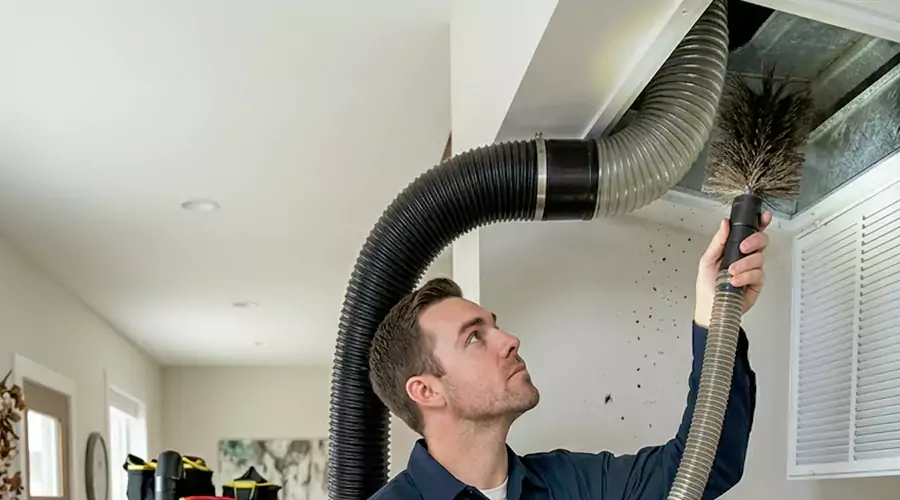
Professional air duct cleaning typically takes 3 to 8 hours for a residential home, depending on the system's size, accessibility, and condition. Some straightforward whole-system cleanings can be completed in 2 to 4 hours by a two-person crew, while larger homes or heavily contaminated systems may require most of a working day. The exact duration depends on the number of ducts, HVAC systems, and components included in the service.
Air duct cleaning involves removing accumulated dust and debris from heating and cooling ductwork. Professional technicians use specialized collection equipment and tools designed to loosen contamination from duct surfaces. A properly performed service includes preparation, cleaning, and final inspection rather than simply vacuuming the visible openings.
Many homeowners want to know how long the appointment will take before arranging time away from work or preparing their homes. The schedule can vary substantially because no two duct networks have exactly the same layout.
Understanding the cleaning process helps homeowners estimate how much time to allow and recognize when an unusually short appointment may not cover the agreed work.
How Long Does Whole-House Air Duct Cleaning Take?
HomeGuide estimates that a two-person crew can complete many whole-system residential duct cleanings in approximately 2 to 4 hours. Angi's October 2026 cost guide describes a broader 3 to 8-hour range, with a typical household appointment sometimes taking 5 to 7 hours.
These estimates are not contradictory because crew size, cleaning scope, and system complexity differ. A compact single-system house with accessible ducts may require less time than a large multistory property with several HVAC units.
| Residential Cleaning Project | Illustrative Duration |
|---|---|
| Small home with an accessible duct system | 2–4 hours |
| Typical residential whole-system cleaning | 3–6 hours |
| Larger home with many registers | 5–8 hours |
| Two or more HVAC systems | May require a full day or longer |
| Heavy contamination or difficult access | Additional time based on inspection |
| Specialized remediation or duct repair | Separate project schedule |
These ranges are estimates rather than guaranteed completion times. A contractor should inspect the system and identify its cleaning scope before providing an appointment window.
What Factors Affect Air Duct Cleaning Time?
The size of the house influences the number of ducts and registers technicians need to access. However, square footage alone does not establish the duration. The layout and actual condition of the HVAC system can be equally important.
Number of Supply and Return Vents
Each supply register connects to a branch that may require cleaning. Return ducts also need attention because they carry room air back toward the HVAC equipment.
A home with eight registers generally has fewer cleaning access points than one with twenty. However, the length of the branches and their accessibility can change the time required.
Number of HVAC Systems
A home containing two furnaces or air handlers may have separate duct networks. Each system can require its own vacuum setup, cleaning sequence, and inspection.
The contractor should confirm how many systems are included in the price. An advertised whole-house service may not automatically include every HVAC system on the property.
Ductwork Accessibility
Exposed basement ducts may offer convenient service access, while concealed attic branches can require more preparation. Some systems need temporary service openings to reach otherwise inaccessible areas.
NADCA notes that such openings must be created and closed using proper procedures. This work can add time but may be necessary for adequate cleaning.
Type of Duct Material
Bare metal ducts may allow different cleaning tools from insulated flexible ducts or fiberglass duct board. Delicate liners require methods that do not damage their surfaces.
Technicians should identify the duct materials before choosing agitation equipment. The appropriate procedure may take longer when aggressive brushing is unsuitable.
Amount of Contamination
Light deposits may be easier to remove than extensive construction debris or heavy accumulated material. Significant contamination can require additional passes and inspection.
Pest contamination or suspected mold may also call for specialized assessment or remediation. These situations should not be treated as routine cleaning appointments without evaluating the hazards.
How Long Does Each Step of Air Duct Cleaning Take?
Professional duct cleaning consists of several stages. The time spent on each stage varies by system, and some activities may overlap when several technicians work together.
| Cleaning Stage | Illustrative Time |
|---|---|
| Initial inspection and walkthrough | 15–30 minutes |
| Protecting work areas and equipment setup | 20–45 minutes |
| Supply and return duct cleaning | 1–4 hours or more |
| Applicable HVAC component cleaning | 30–90 minutes |
| Final inspection and cleanup | 20–45 minutes |
These time ranges are examples, not a standardized industry timetable. Some activities may occur simultaneously, so adding every maximum would not provide a reliable total. The agreed service scope determines the actual schedule.
Initial Inspection
Technicians begin by locating the HVAC equipment, supply registers, return grilles, and relevant service openings. They should also identify duct material and visible damage.
This stage helps determine which tools can be used safely. If the inspection reveals wet insulation or serious contamination, the cleaning plan may need to change.
Equipment Setup
A professional crew connects its collection equipment and protects the surrounding work areas. Depending on the system, temporary openings or connections may be needed to establish suitable negative pressure.
NADCA recommends maintaining negative pressure during source-removal cleaning so loosened material can be collected instead of released into living spaces.
Supply and Return Duct Cleaning
This is often the longest stage. Technicians use suitable agitation tools to loosen deposits while vacuum equipment captures the debris.
Branches and larger passages may require separate access and repeated cleaning. The amount of time depends on the network's layout and the condition of its surfaces.
HVAC Component Cleaning
The agreed scope may include accessible plenums, registers, blower components, and other suitable HVAC surfaces. NADCA recommends considering the connected system because dirty components can reintroduce debris after ducts have been cleaned.
Some specialized maintenance tasks require qualified HVAC personnel. The contractor should explain whether coil or blower cleaning is included or provided separately.
Final Inspection and Cleanup
After cleaning, technicians inspect accessible components and restore any temporary service openings. Registers and equipment panels should be reinstalled correctly.
The crew should remove collected debris and verify that the system is ready for normal operation. Any duct damage discovered during cleaning should be reported to the homeowner.
Can Air Duct Cleaning Be Completed in One Hour?
A limited task, such as cleaning several accessible registers, may take less than an hour. However, this is not equivalent to cleaning an entire residential supply and return duct network.
A company offering very short whole-house appointments should explain how it will clean all components included in its proposal. NADCA's source-removal method involves equipment setup, negative-pressure collection, agitation, and cleanliness verification. An appointment's duration alone does not prove good or poor workmanship. The important question is whether the contractor completes the agreed work using appropriate methods.
Do You Need to Leave the House During Air Duct Cleaning?
Homeowners can often remain in the house during ordinary professional cleaning, although some rooms may be temporarily inaccessible. The contractor should explain where equipment and hoses will be positioned.
Children and pets should remain away from active work areas. If specialized contamination or chemical treatment is involved, different precautions may apply. Ask the company about occupancy requirements before the appointment. Ordinary source-removal cleaning and specialized remediation should not be assumed to have identical safety procedures.
How Should You Prepare for an Air Duct Cleaning Appointment?
Basic preparation can help technicians access registers and HVAC equipment without unnecessary delays.
Before the appointment:
- Move furniture away from supply and return grilles.
- Clear access to the furnace or air handler.
- Identify rooms containing registers.
- Secure pets away from work areas.
- Remove fragile items near equipment pathways.
- Inform the contractor about damaged ducts or moisture problems.
- Confirm parking and equipment access requirements.
- Review which services are included in the quote.
The technician should explain whether the HVAC system needs to remain off during cleaning. Homeowners should not remove equipment panels or disturb unfamiliar insulation in preparation for the appointment.
How Much Does Air Duct Cleaning Cost?
Angi's October 2026 data places professional residential duct cleaning at approximately $271 to $509, with an average around $389. HomeGuide reports $450 to $1,000 for broader cleaning estimates.
Larger homes and difficult access may increase both labor time and cost. Additional services, including duct repairs and specialized remediation, can also change the project price. Ask whether the estimate includes all supply and return ducts, appropriate HVAC components, temporary access openings, and cleanup. A written scope makes it easier to understand what the appointment should cover.
How Can You Tell When Cleaning Is Finished?
A reputable contractor should inspect the completed work and explain which components were cleaned. NADCA's ACR standard addresses inspection and cleanliness verification as part of professional HVAC cleaning.
Ask to review accessible before-and-after photographs where practical. Any temporary openings should be properly closed, and registers should be returned to their original positions. The HVAC system should operate normally after the service. Unusual noise, disconnected ducts, or damaged insulation should be reported and addressed before the work is accepted.
Conclusion
Residential air duct cleaning generally takes 3 to 8 hours, although smaller systems cleaned by an experienced two-person crew may take only 2 to 4 hours. The schedule depends on home size, vent count, duct accessibility, and cleaning scope. Proper cleaning includes inspection, controlled debris removal, and final checks. Preparing access to registers and equipment can reduce unnecessary delays. Ask the contractor for a written scope and a realistic appointment window based on your HVAC system.